Aworth News
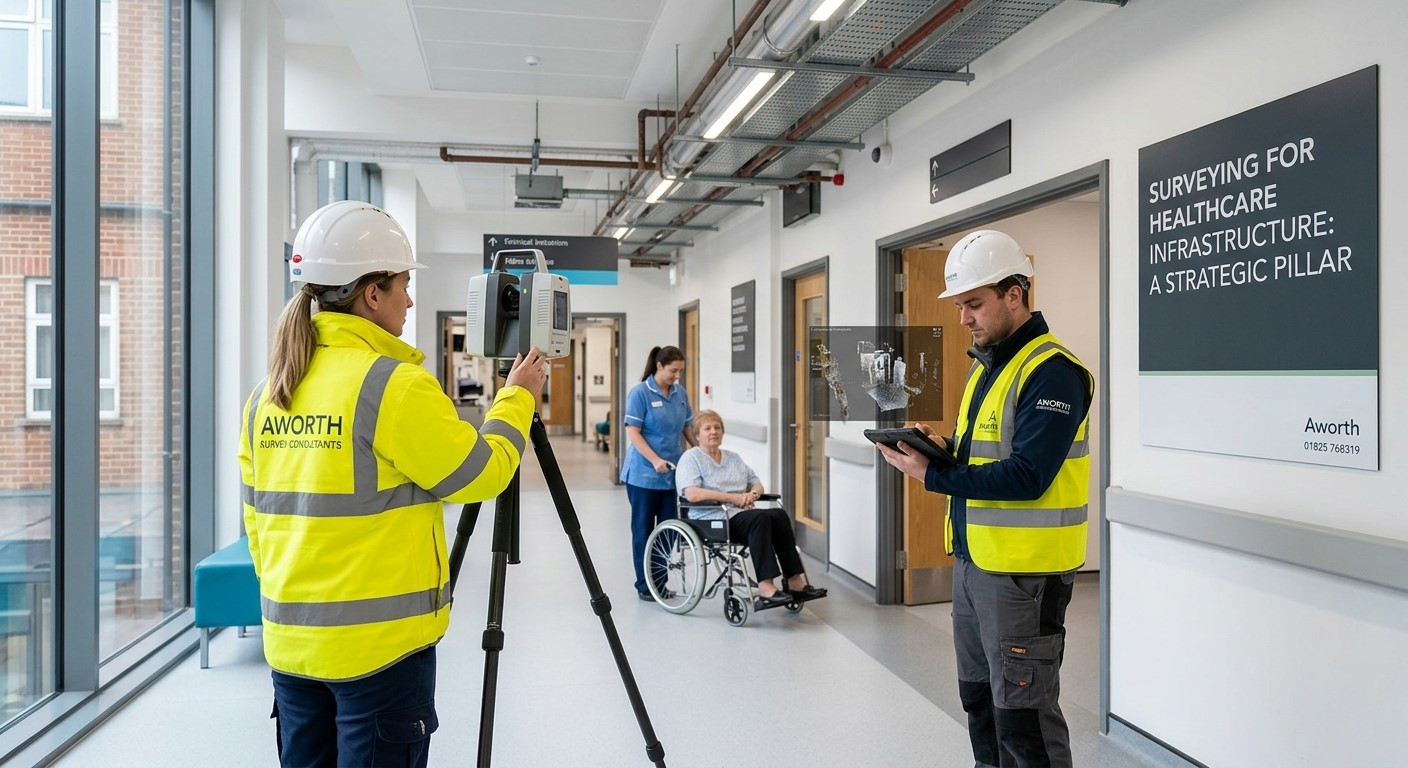
Surveying the UK Healthcare Sector: A Strategic Pillar
September 24, 2026
UK healthcare infrastructure represents one of the most complex and demanding built environments in the world.
As the NHS and private healthcare providers navigate an era characterised by ageing assets, stringent regulatory mandates, and the imperative for digital transformation, the role of land surveying and measured building surveys has shifted from a peripheral technical requirement to a central strategic pillar of estate management.
Aworth Survey Consultants leads the industry in delivering these services, providing the foundational "single source of truth" necessary for maintaining operational continuity and facilitating large-scale redevelopment projects.
Design from Reality, Not Assumptions
A primary cause of project failure in healthcare redevelopment is "designing from assumptions" based on outdated 2D plans.
The Strategic Necessity of Measured Surveys in Healthcare Infrastructure
Healthcare facilities require a level of spatial precision that exceeds standard commercial requirements. Hospital campuses are often a mix of Victorian structures, mid-century additions, and modern modules. This architectural complexity often results in a deficit of accurate "as-built" documentation, posing significant risks during maintenance.
Measured building surveys address this by delivering current floor plans, elevations, cross-sections, and roof plans, provided in 2D AutoCAD or 3D Revit formats, which integrate directly into the workflows of architects, structural engineers, and facilities managers.
Given the technological evolution in surveying methodologies, 3D laser scanning "Reality Capture" technology allows for accurate data acquisition with minimal clinical disruption.
- Non-Contact Measurement: Enables surveying in "hot" environments (e.g., infectious wards or cleanrooms) without physical surface contact.
- Rapid Acquisition: Captures millions of points per second, drastically reducing time spent in occupied clinical areas.
- Historical Record: Creates a "point cloud" snapshot in time, providing an invaluable reference for monitoring long-term structural changes.
Geospatial Intelligence: Land and Topographical Surveying
While building surveys focus on the internal environment, topographical surveying addresses the broader hospital campus. These surveys capture a precise record of both natural and man-made features. For healthcare trusts managing large estates, this intelligence is vital for master planning, parking optimisation, and emergency vehicle access.
Furthermore, as the NHS aligns with the Estates Net Zero Carbon Delivery Plan, mapping existing vegetation, green spaces, and water features has become essential for sustainable development and accurate flood risk assessment.
The Subsurface Dimension: Underground Utility Mapping
Following PAS 128 standards, we use Ground Penetrating Radar (GPR) and Electromagnetic Location (EML) to map critical underground services networks.
For healthcare providers, the primary benefit of a PAS 128 survey is risk mitigation; a single utility strike can result not only in massive repair costs but also in the dangerous, unplanned shutdown of essential services like A&E or surgical departments.
Boundary Definition and Legal Safeguarding
The development of hospital estates over several decades often leads to ambiguity in boundaries.
By combining desktop research of property deeds and Ordnance Survey maps with on-site measurements, boundary surveys identify exact legal lines. This proactive approach prevents the costly disputes and project delays that occur when extensions or infrastructure encroach on adjacent private or municipal land.
Regulatory Compliance and Professional Standards
Surveying in the UK healthcare sector is governed by a robust framework of standards. Aworth Survey Consultants are regulated by The Royal Institution of Chartered Surveyors (RICS), ensuring that all work meets the highest benchmarks for quality, consistency, and safety.
The Financial Case: ROI
Professional surveys should be viewed as high-yield investments:
- Preventing Expensive Surprises: Accurate data avoids errors in construction, preventing delays that can cost thousands per day.
- Supporting Business Cases: Verified spatial data provides the evidence required for planning permission and capital funding approvals.
Strategic Recommendations
To ensure safety, efficiency, and sustainability, we would always recommend:
- Establish Data Governance: Maintain accurate, updated records as a unified "single source of truth."
- Adopt a BIM-Centric Policy: Mandate high-resolution 3D scans and BIM-compliant Asset Information Models (AIM) for all major work.
- Prioritise Subsurface Intelligence: Use PAS 128 mapping before all groundworks.
- Optimise Space Utilisation: Leverage digital twin technology to identify and repurpose underused space.
By treating spatial data as a foundational asset, healthcare providers can ensure long-term resilience and operational excellence across their entire estate portfolio.
We welcome the opportunity to discuss your requirements. Please contact us at 01825 768319 or via email at als@aworth.co.uk.
Head Office
Norfolk House, Norfolk Way,
Uckfield, East Sussex TN22 1EP
T: 01825 768 319
London Office
The Lansdowne Building,
2 Landsdowne Road, Croydon CR9 2ER
Newsletter
Subscribe to our mailing list to keep in touch with all the latest news or follow us on:








© 2026 Aworth Survey Consultants. All rights reserved.
Site by: Networld Design